
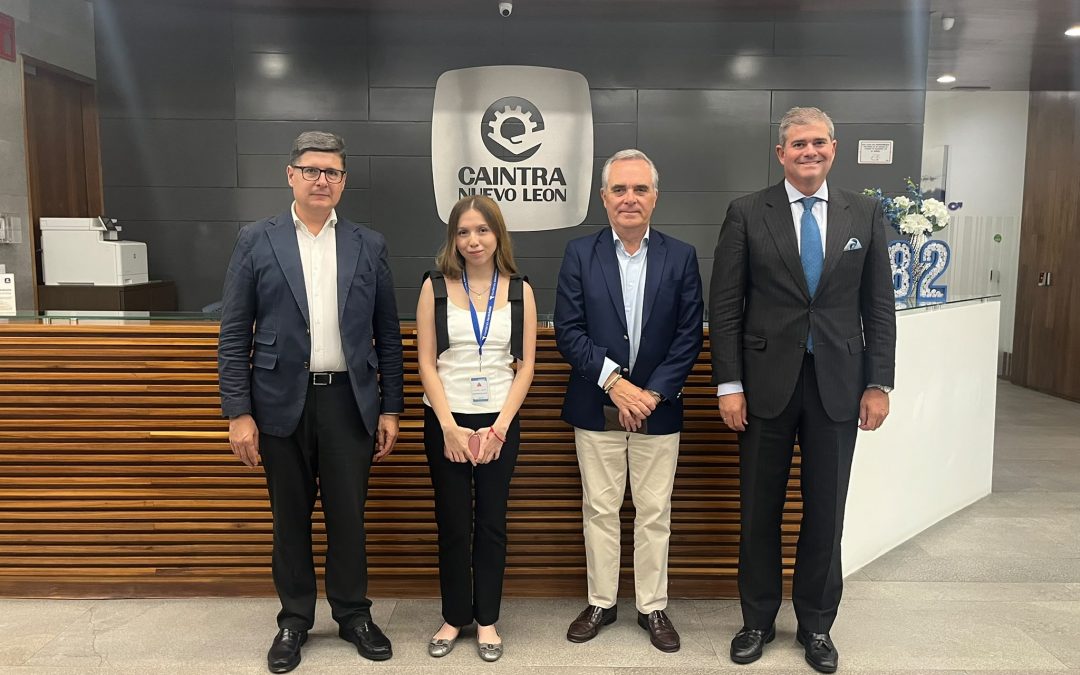
- A delegation from the Seville City Council is strengthening its collaboration with Nuevo León’s leading technology, logistics, and aerospace clusters to attract investment, talent, and companies to Seville
- The business meetings held this week in Mexico reinforce the strategy of the “Sevilla Open for Business” office and open up new avenues for cooperation in innovation, industry, artificial intelligence, logistics, and business development
The business mission organized by the Seville City Council this week in Mexico concluded its final day of work in Monterrey with a packed schedule of meetings aimed at strengthening the Andalusian capital’s international standing as a preferred destination for investment and business expansion by Mexican organizations.
Juan Bueno, the delegate from the Ministry of Finance, and Álvaro Pimentel, the delegate from the Ministry of Economy, along with Manuel Parejo, director of the investment promotion office “Sevilla Open for Business,” held meetings with some of the leading economic and institutional stakeholders in the state of Nuevo León, considered Mexico’s largest industrial and technological hub and one of North America’s economic powerhouses.
The event provided an opportunity to showcase Seville’s economic potential to organizations representing thousands of companies and professionals in strategic sectors such as technology, logistics, artificial intelligence, industry, and aeronautics. The meetings also served to identify opportunities for collaboration, foster future business relationships, and advance a work plan designed to attract new investment to Seville.
The first meeting was held with representatives from the Monterrey IT Cluster, CSOFT Monterrey, and the Nuevo León Logistics Cluster—three organizations that play a key role in the state’s technological and industrial development. These clusters operate under a collaborative model involving companies, universities, and public administrations to drive innovation, promote knowledge transfer, and enhance business competitiveness.
The three business organizations bring together approximately 300 companies and maintain cooperative relationships with international technology ecosystems, drawing on a network of thousands of engineering professionals who develop projects for technology and industrial companies of all sizes.
“Spain—and Seville in particular—is a market of great interest to companies involved in software development, cybersecurity, artificial intelligence, and technology services. We have Seville TechPark, a space where we can connect research centers and promote joint programs between Seville and Monterrey,” explained Juan Bueno, the city’s finance delegate and spokesperson.
Another of the day’s most significant meetings took place with Monterrey Aerocluster, one of the leading business organizations in the Mexican aerospace sector and a key player in coordinating efforts among companies, government agencies, universities, and technology centers to strengthen the industry’s competitiveness.
“Seville’s industrial capacity in the aerospace sector is a strength recognized by all Mexican companies in the industry,” Bueno noted. “At first glance, there is an extraordinary degree of complementarity between the industrial ecosystems of Nuevo León and Seville; we have been able to identify numerous opportunities to facilitate the exchange of information, connect companies, and promote future joint initiatives between business organizations in both regions,” he added.
The day concluded with an institutional meeting with Regina Sada Elizondo, Director of Foreign Investment for the State of Nuevo León, along with officials from the innovation department, representatives of the Spanish Chamber of Commerce in Mexico, and members of the regional government’s team responsible for attracting international investment.
The economic model of Nuevo León—considered the state with the greatest industrial capacity in Mexico and one of the continent’s leading destinations for foreign investment—features a productive sector comprising more than 4,500 foreign companies operating in sectors such as technology, the automotive industry, manufacturing, logistics, steel, aluminum, food, and data centers.
“Seville is experiencing an unprecedented period of growth in the technology, industrial, energy, and aeronautics sectors, which offers these companies the opportunity to expand their international presence by establishing themselves in our city,” said the municipal spokesperson, who explained that “we cannot let this opportunity to collaborate on future joint initiatives pass us by, as these initiatives will help strengthen business ties between our two regions and facilitate new investments.”
With this final day of work, the Seville City Council concludes a business mission that has made it possible to establish contacts with some of Mexico’s leading economic and institutional players, strengthen Seville’s international positioning as a competitive destination for investment, and open new avenues for collaboration in high-value-added sectors. The strategy promoted through “Sevilla Open for Business” thus continues to expand the city’s international presence with a clear objective: to attract new companies, create quality jobs, and consolidate Seville as one of the major economic, technological, and industrial hubs in Southern Europe.