
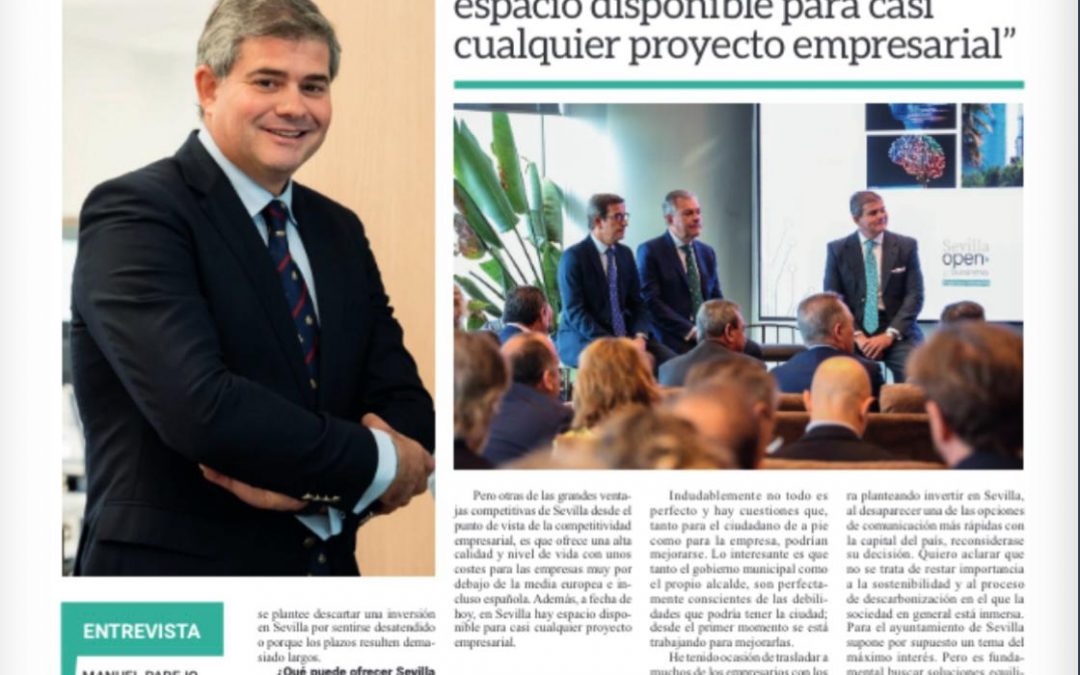
Interview originally published by Tribuna de Andalucía in its November 2023 issue.
You have just taken over the management of the Sevilla Open for Business office. Why did you decide to create this new organization?
The decision to create this office came directly from the mayor of Seville, José Luis Sanz. Even before he was elected to office, he was aware that Seville had a series of problems of depopulation, unemployment and low specific weight of industry, which made it advisable to avoid immobility and "make a move". The mayor has always been convinced that Seville must be a "friendly" city for business investment, especially in sectors with high added value and that generate quality employment. In short, the idea is that no investor should consider discarding an investment in Seville because they feel neglected or because the deadlines are too long.
What can Seville offer investors at this time?
Seville is not only a great city with an extraordinary attraction potential due to its culture, monuments, gastronomy or climate. Seville is the economic and administrative capital of Andalusia. It has an airport through which more than 7 million passengers pass every year; it has a total of 75 destinations operated by 20 companies and carries out more than 60,000 operations every year. Seville has the only inland commercial port in Spain. It also has a Science and Technology Park, Cartuja, just a 10-minute walk from the city center. This park brings together 557 companies and startups, training and research centers. Its economic activity amounted to 4,490 million Euros in 2022 and it had 29,159 workers. There are 193 research groups in the park and 753 R&D&I projects started in 2022; 31 patents granted and a total of 70 startups in incubators.
But another of Seville's great competitive advantages from the point of view of business competitiveness is that it offers a high quality of life and standard of living with costs for companies well below the European and even Spanish average. Moreover, as of today, there is space available in Seville for almost any business project.
"In short, the idea is that no investor should consider discarding an investment in Seville because they feel neglected or because the deadlines are too long".
It is also necessary to take into account the weakest points highlighted by businessmen, such as the lack of infrastructure, or the fact that Seville has six of the fifteen poorest neighborhoods in Spain.
Undoubtedly, not everything is perfect and there are issues that, both for the ordinary citizen and for the company, could be improved. The interesting thing is that both the municipal government and the mayor himself are perfectly aware of the weaknesses that the city might have; from the very first moment they are working to improve them. I have had the opportunity to convey to many of the businessmen with whom I have met in recent weeks, that in order to make progress on these issues that can be improved, it will be very important to know the opinion of companies and investors. In terms of infrastructure, the mayor himself has recently stated that he is waiting for a government to be formed in the country, to have an interlocutor to request and claim the improvements in infrastructure that the city should have.
The possibility of restricting flights on shorter routes when there is a train to cover them has recently been announced. How do you assess this announcement and how do you think it could affect your intention to attract investment to Seville?
Undoubtedly, the mere fact of announcing such a measure already raises questions and concerns among investors. Money and investment are very cautious and cautious; they need certainty and legal security. It could be the case that someone who was considering investing in Seville, when one of the fastest communication options with the capital of the country disappears, might reconsider their decision. I would like to make it clear that this is not to undermine the importance of sustainability and the decarbonization process in which society in general is immersed. For the Seville City Council it is, of course, a matter of the utmost interest. But it is essential to seek balanced solutions that do not jeopardize business and employment. Hopefully the flight will finally be maintained, but unfortunately, much of the damage has already been done.
Administrative simplification is an objective that all governments at all levels are always striving for. Why do you think it is so difficult to achieve?
I believe there are two main factors. Firstly, because administrative processes also require security and full guarantees, which sometimes make them quite complex and lengthy. Secondly, because of the inertia that some administrations have of dragging out certain processes.
From the Sevilla Open for Business office we will work so that these two issues, of course always acting in accordance with the law for each procedure, can be improved and streamline the procedures to generate business activity in Seville.